
Add GPT, Claude and Gemini to the software you already run
Softsols builds secure RAG search, in-app AI copilots, document AI and LLM-powered automations that are grounded in your data, measured against real test sets and protected by guardrails.
- Proof of concept on your data
- Model-agnostic: OpenAI, Claude, Gemini
- PII redaction and audit logs
- You own the code and prompts
AI integration and LLM development services
From a single AI feature to a full retrieval-augmented platform, we handle architecture, development, evaluation and rollout.
RAG and Knowledge Search
Retrieval-augmented generation over your documents, wikis and databases, with citations so users can verify every answer.
In-App AI Copilots
Assistants inside your SaaS or internal tools that draft, summarise, explain and take actions for the user.
Document AI and Extraction
Turn invoices, contracts, medical forms and emails into structured data, with human review for low-confidence fields.
AI Chatbots and Voice Assistants
Customer-facing chat and voice assistants connected to your CRM, helpdesk and order systems.
Learn more →LLM API Integration
Secure server-side integration of OpenAI, Claude, Gemini or open-source models into web and mobile apps.
Evals, Guardrails and LLMOps
Test sets, automated evals, prompt versioning, PII redaction, cost tracking and production monitoring.
Make existing software smarter, without a rebuild
Most companies do not need a brand-new AI product. They need the software they already have to answer questions, draft documents, search their own data and automate repetitive work.
We start small with one high-value use case, prove the ROI on your real data, and then scale it across your product. Typical goals: faster support with AI-drafted answers, hours saved on document review, instant search across PDFs and tickets, and copilot features that improve retention and pricing power.
Why teams choose Softsols for AI
- 01Model-agnosticWe compare 2 to 3 models on your data for quality and cost, then recommend.
- 02Measured, not guessedEvery feature ships with a test set and automated evaluations.
- 03Security firstKeys stay server-side, outputs are logged, and PII can be redacted before it reaches a model.
- 04Private deployment optionsAzure OpenAI, AWS Bedrock, Vertex AI or self-hosted open-source models for regulated data.
- 05Full-stack teamThe same team builds the AI, the app, the APIs and the infrastructure.
From proof of concept to production
Short sprints, demos you can click, and a single accountable project manager from kickoff to launch.
- Use-case workshopPick one use case with clear ROI, agree metrics and a test set.
- Proof of conceptA working prototype on your data, compared across models.
- Production buildSecure APIs, guardrails, logging, human review and integration.
- Monitor and improveOngoing evals, cost tracking and model upgrades.
AI and automation work
Document AI, support chatbots, publishing automation and AI-assisted SaaS.
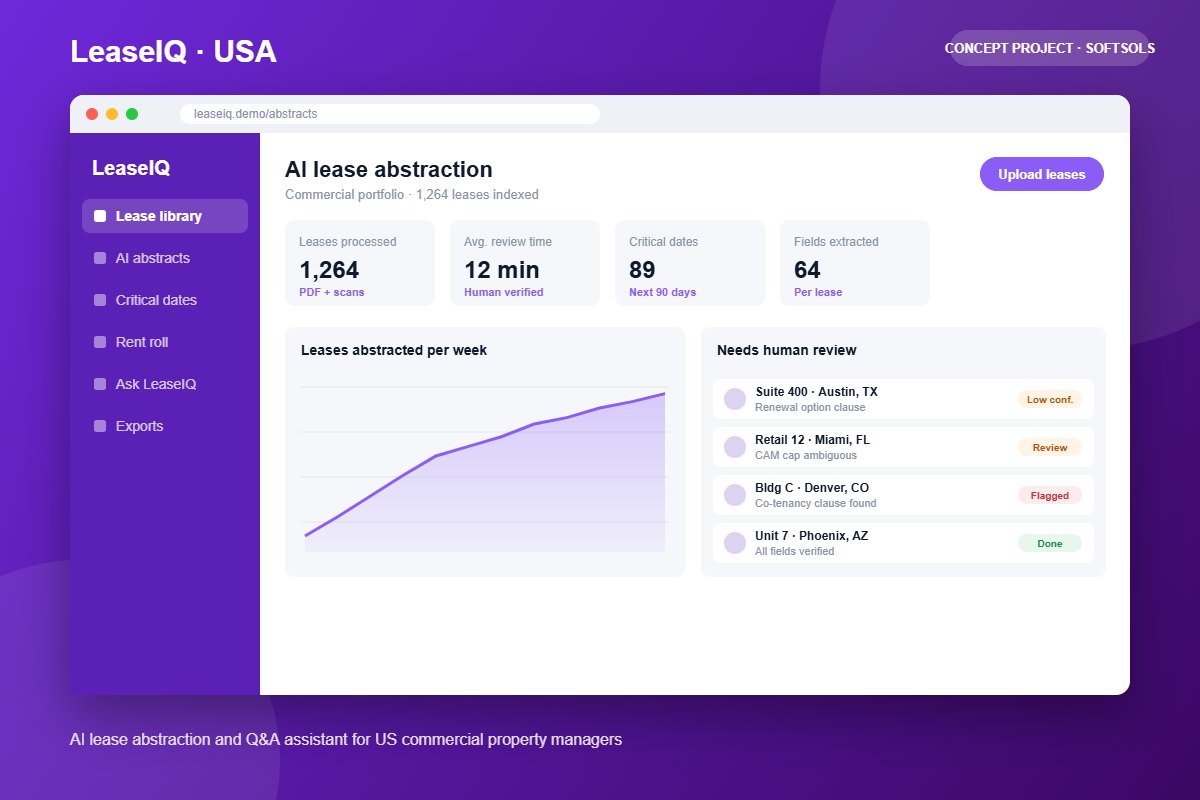
LeaseIQ – AI Lease Abstraction, USA
AI assistant that extracts key dates, rent terms and clauses from commercial leases for US property managers.
View case study →
AI-Powered Customer Support Chatbot
AI chatbot that resolves order and shipping questions for an e-commerce support team.
View case study →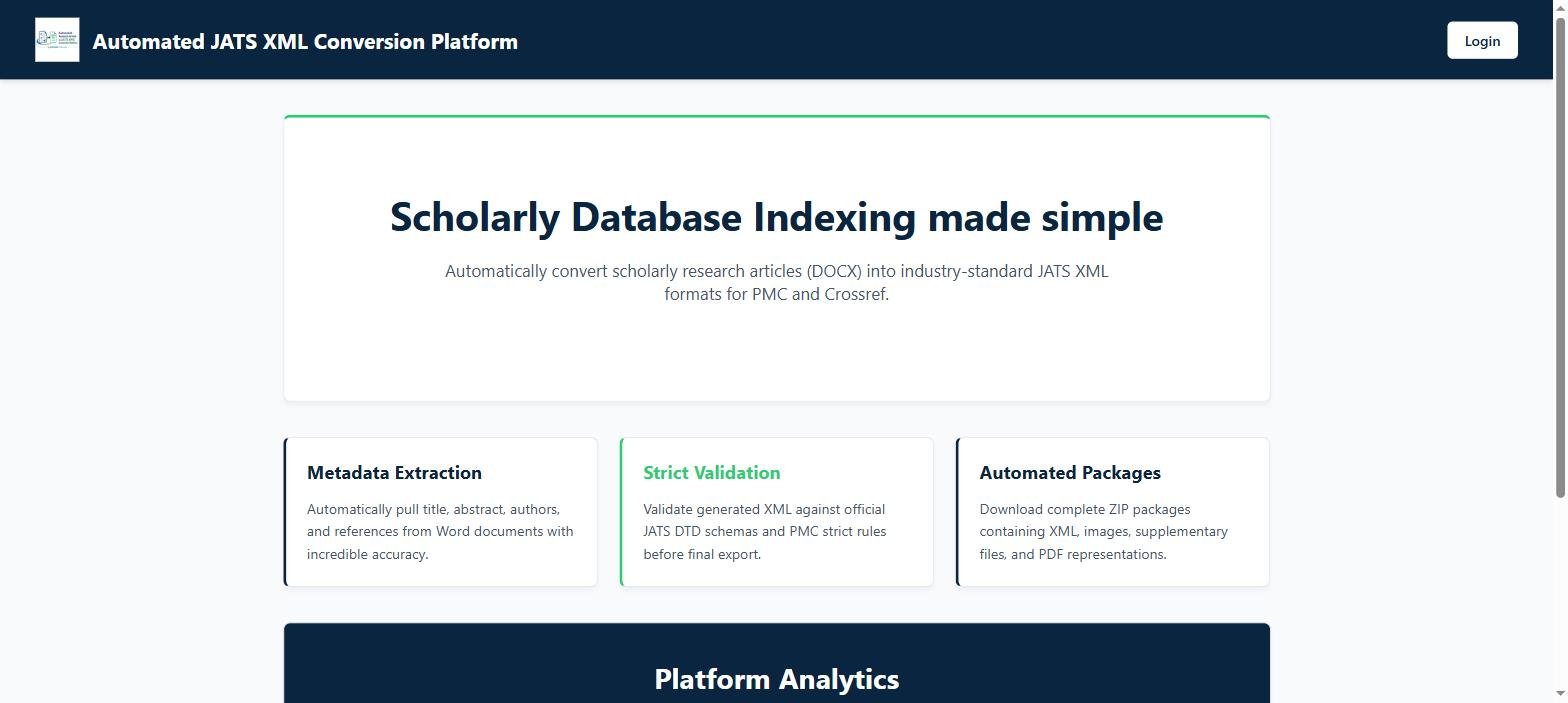
JATXML Portal
Automates conversion of scholarly manuscripts into JATS XML for journal publishing workflows.
View case study →
WhatsApp Marketing Automation Suite
WhatsApp marketing automation suite for campaigns, broadcasts and lead follow-up.
View case study →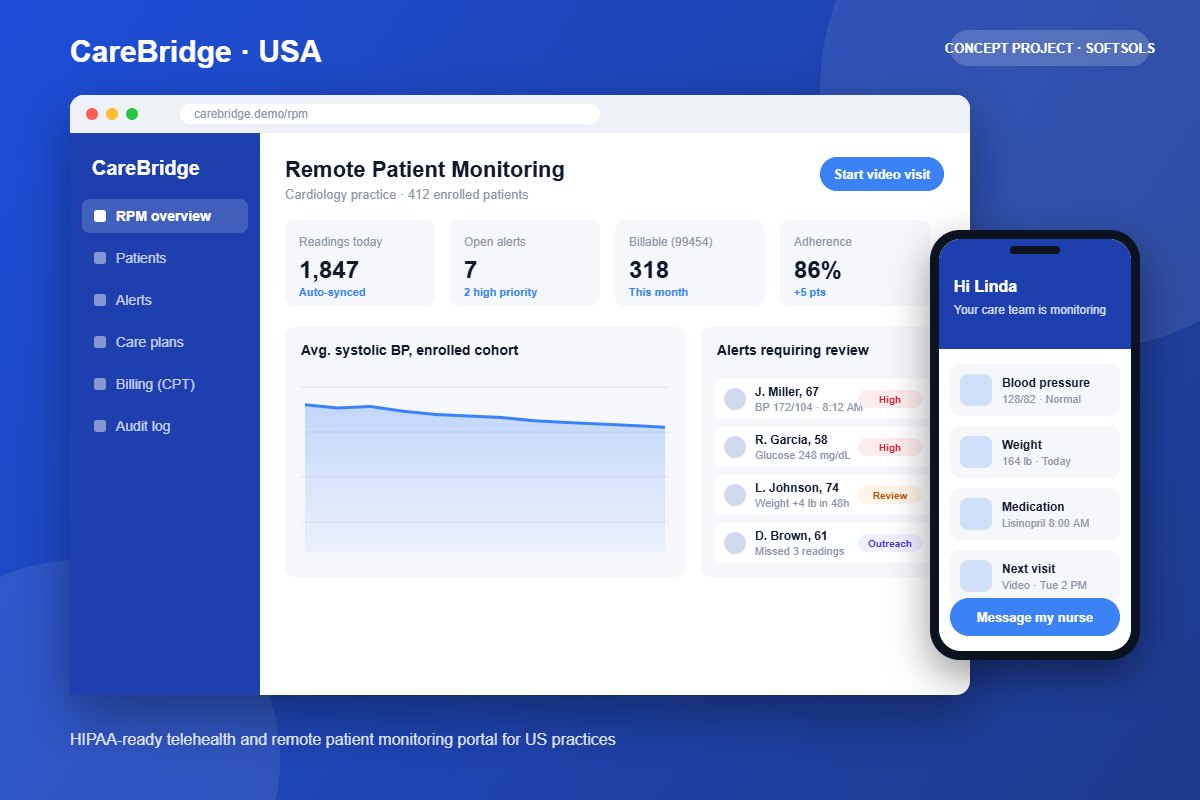
CareBridge – Telehealth & RPM Portal, USA
HIPAA-ready telehealth and remote patient monitoring portal with device data and clinician dashboards.
View case study →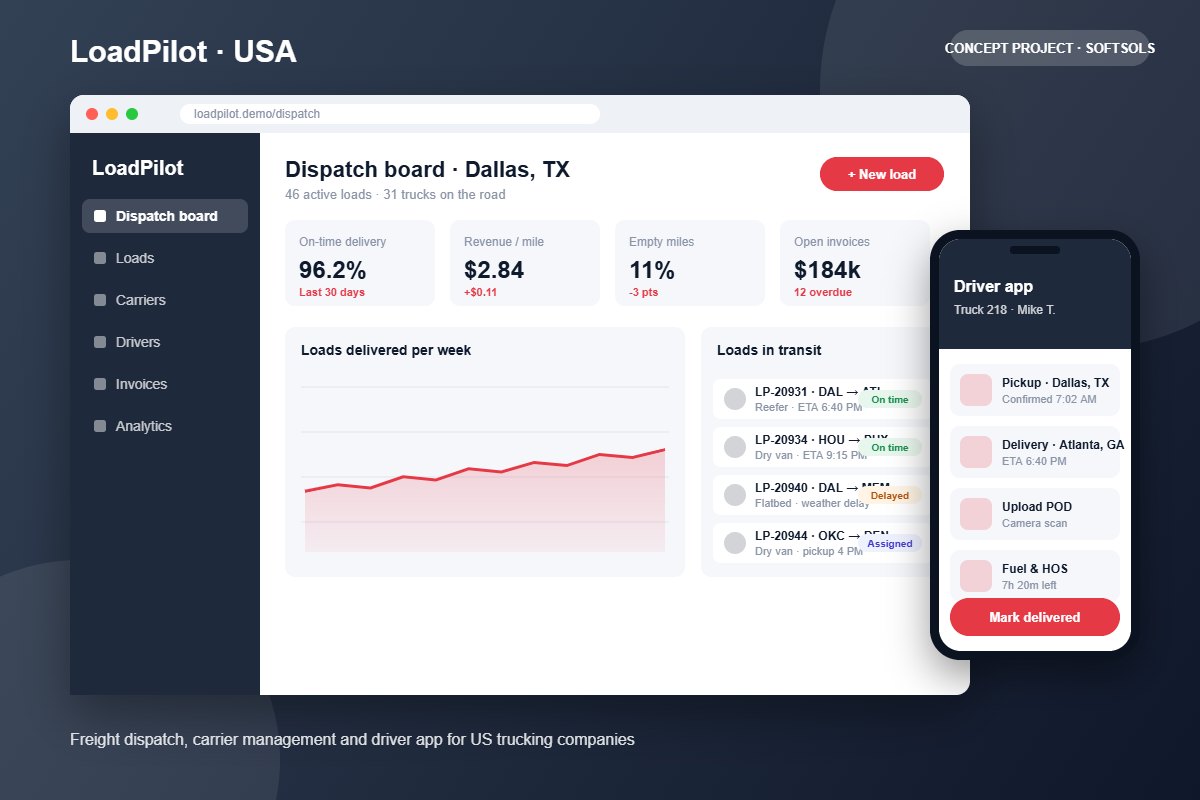
LoadPilot – Freight Dispatch SaaS, USA
Dispatch, load tracking and carrier management SaaS for small US trucking fleets and brokers.
View case study →Concept projects are reference builds and solution designs that show our approach; they are clearly labelled and are not client engagements.
Tools and technologies we use
Models
Frameworks
Retrieval
Platforms
Where LLM integration pays off fastest
SaaS
In-app copilots that write reports and answer how-do-I questions, for retention and fewer tickets.
Healthcare
Clinical note summarisation and patient message triage, HIPAA-aware.
Legal and Finance
Contract clause extraction and risk flagging for faster review cycles.
Logistics
Email-to-order extraction and shipment status assistants that cut manual entry.
Flexible ways to work with us
Fixed-Price Proof of Concept
Validate one AI use case on your real data before committing to a build.
- Use-case workshop
- 2 to 3 models compared
- Quality and cost report
- Go / no-go recommendation
Production AI Feature
Take the proven use case to production inside your app.
- Guardrails and PII redaction
- Evals and monitoring
- Human-in-the-loop review
- Milestone-based pricing
Dedicated AI Engineers
AI and full-stack engineers working on your roadmap.
- From $3,500 per engineer / month
- LLMOps ownership
- Model upgrades as the field moves
- Scale with 2 weeks notice
Building AI features responsibly
Enterprise-ready by design
API keys stay server-side, prompts and outputs are logged for audit, and personal data can be redacted before it reaches any model. For regulated industries we use zero-retention settings, private cloud deployments or self-hosted open-source models.
Integration or agents?
Single AI features (search, summarise, extract, draft) are integration work. Autonomous, multi-step workflows that take actions across tools are agents. See our AI agent development services for the latter.
Frequently asked questions
What is AI integration?
AI integration connects large language models such as GPT, Claude or Gemini to your existing applications, data and workflows, so your software can answer questions, draft content, extract data and automate tasks.
Which LLM should we use: OpenAI, Claude or Gemini?
It depends on the task, cost and data rules. In the proof of concept we test 2 to 3 models on your real data and recommend based on measured quality and cost per request.
What is RAG and do we need it?
Retrieval-augmented generation lets a model answer from your own documents with citations. You need it whenever answers must reflect your private, current information rather than the model’s general knowledge.
Is our data safe when using LLM APIs?
Yes, when architected properly. We use server-side keys, zero-retention API settings, PII redaction, audit logs and, if required, private deployments on Azure, AWS or Google Cloud.
How long does an AI integration project take?
A proof of concept typically takes 2 to 4 weeks, and a production feature 6 to 12 weeks depending on integrations and review requirements.
How much does AI integration cost?
Proofs of concept are fixed-price and scoped to one use case. Production costs depend on integrations and volume; use our cost calculator for a rough estimate.
Have an AI feature in mind?
Get a free use-case assessment and a fixed-price proof-of-concept proposal.